
HackTheGap: Team Trust Issues and Energy Trading for a Five-Year-Old
I attended my very first in-person hackathon, HackTheGap, and I found it through Swiss {ai} Weeks. All participants are women studying different subjects, with various technical backgrounds and work experience. We spent 2 days tackling the challenge of building a human-in-the-loop AI workflow to help juniors get onboard and help seniors pass down their valuable tacit knowledge.
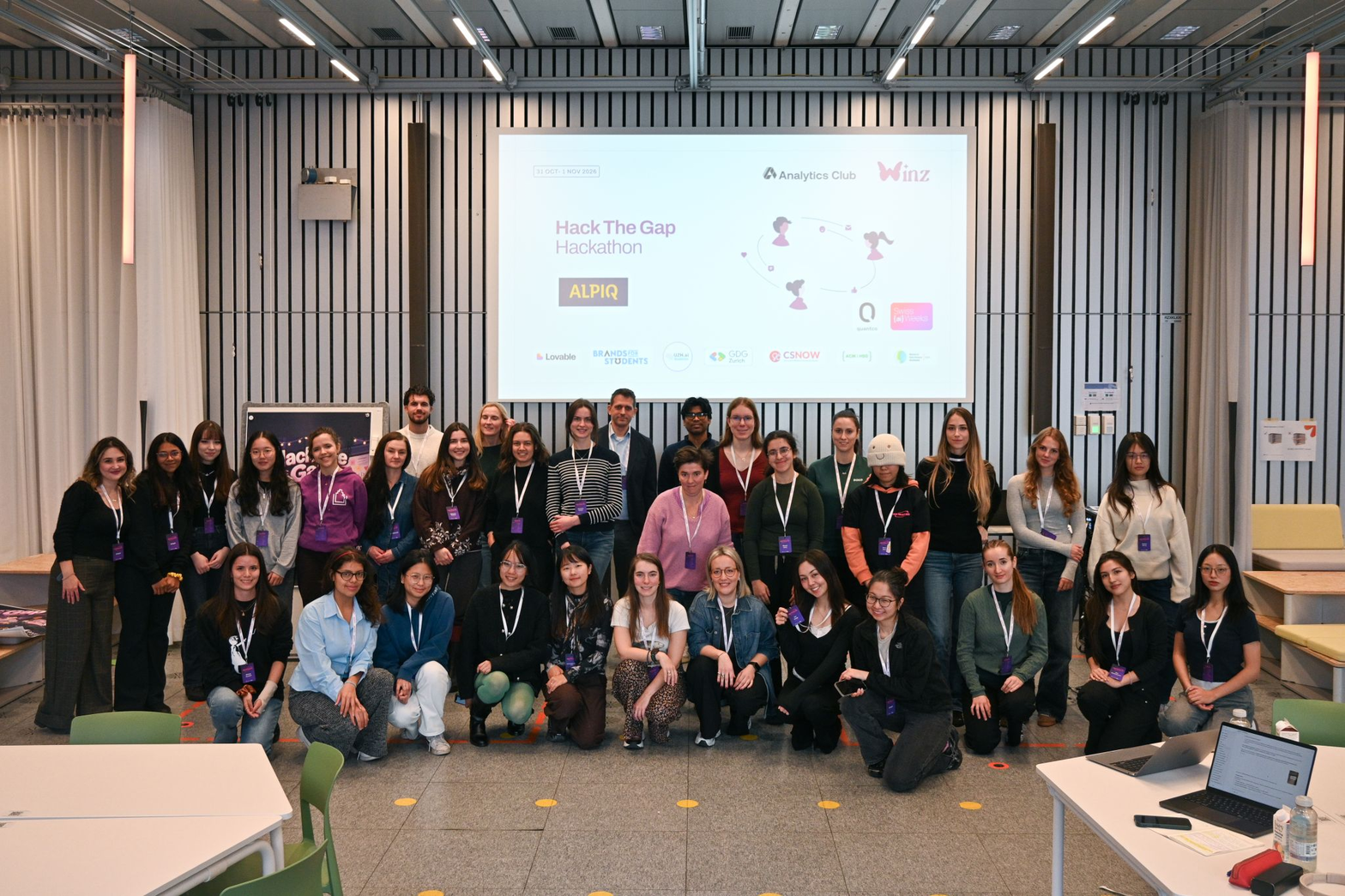
Thanks Alpiq for providing the challenge, and our mentors Zoltán Godó, Mariia Koliada, and Gentian A. Thanks Doğa Menteşe and Akhila Obilisetty from WINZ (Women in Informatics Network UZH, ACM-W Chapter) and the Analytics Club at ETH for organizing the event. The food was amazing :)
Team Trust Issues
Working together with my team Iori Longo, Khanak Gulati, and Vasiliki Tsiantali, and of course our AI agent, our team Trust Issues got 2nd place. As Iori presented in the introduction of the pitch, the trust issues are mainly between the agents and the human. Blindly trusting agents may end up badly…
Explain energy bidding to me like I am five
Beyond the workflow and the prototype, what I learned the most was about energy trading. I have spent most of my life learning science and staring at a very specific field, so how the energy market works was about as far from my day-to-day as it gets.
In the end, my job in the team was to demonstrate our prototype as a junior, which meant I had to actually (try my best to) understand what a junior trader does. So I spent most of the weekend asking AI to explain energy bidding to me like I was five.
Reading explanations only got me so far, so I asked Claude to build me small things to play with instead.
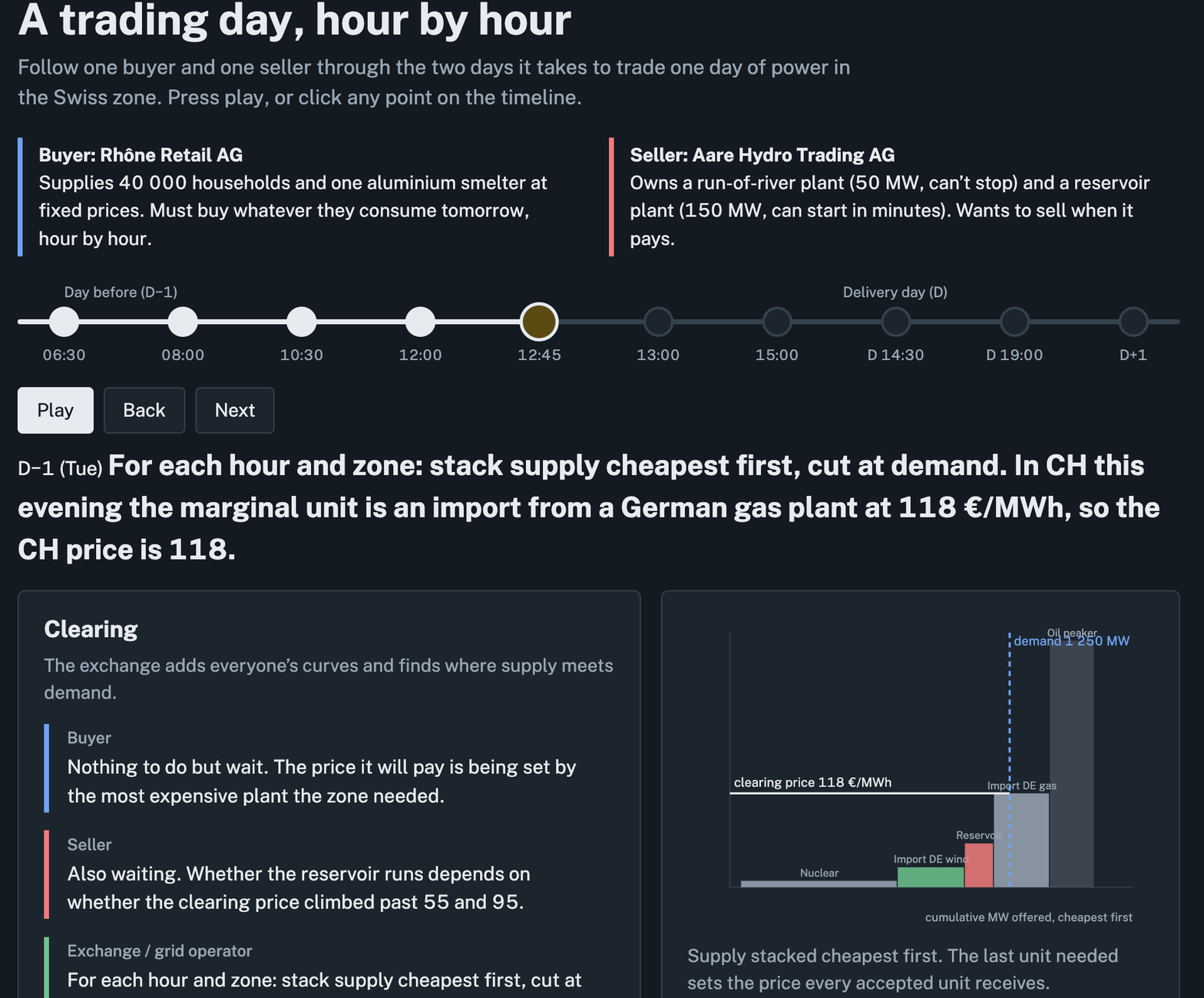
First, a timeline that follows one buyer and one seller through the two days it takes to trade one day of power in the Swiss zone. Click through and see who does what, and when.
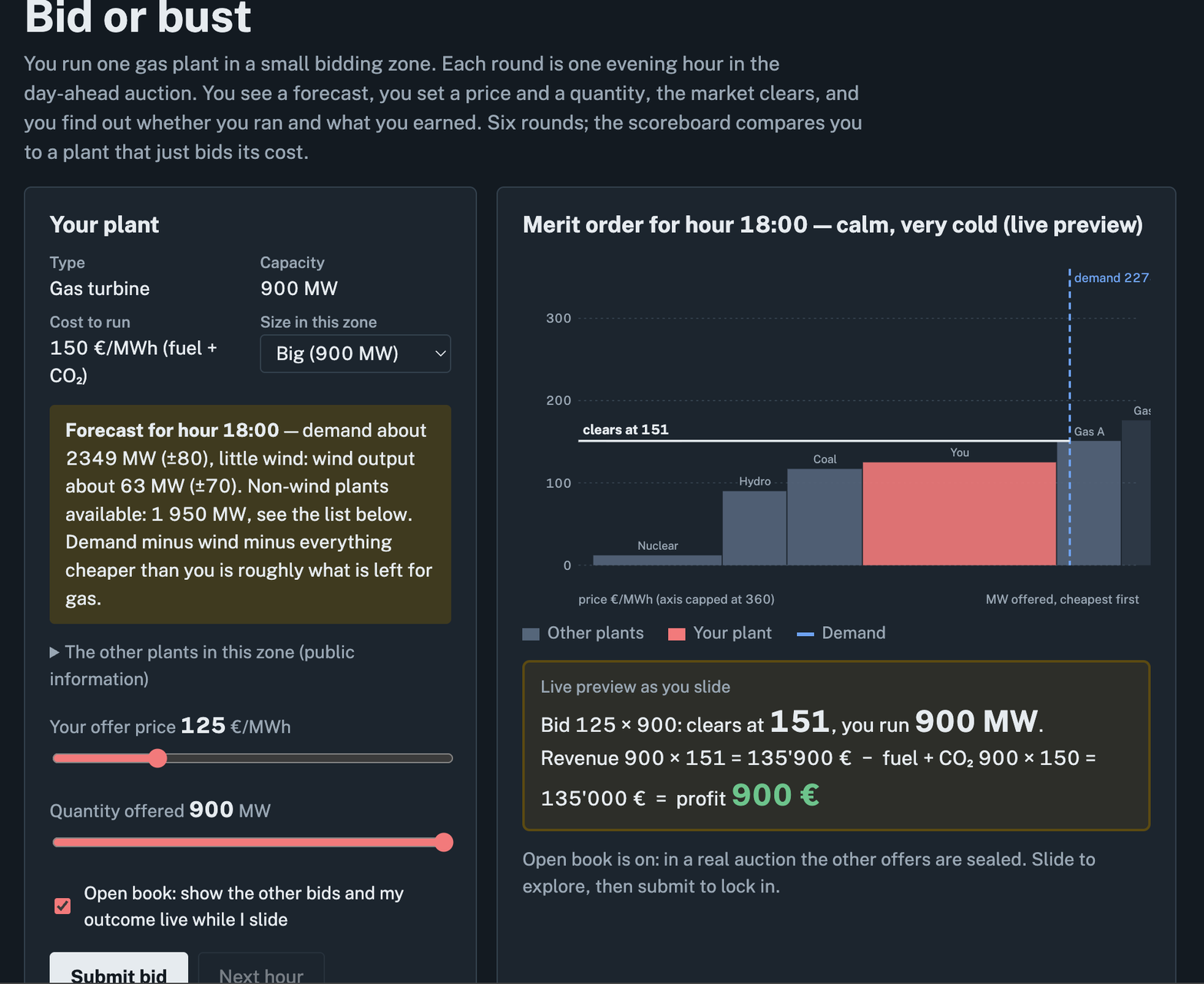
Then a game, “Bid or bust”. I run one gas plant, set a price and a quantity, the market clears, and I find out whether I ran and what I earned. Six rounds, and the scoreboard compares me to a plant that just bids its cost.
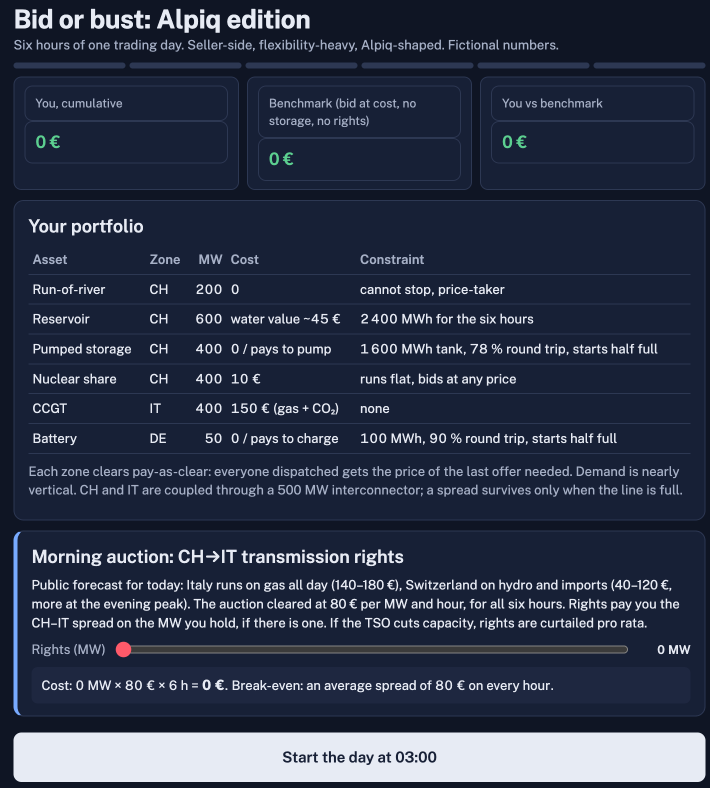
Then the Alpiq-shaped edition (fictional numbers): a whole portfolio with run-of-river, a reservoir, pumped storage, a nuclear share, a gas plant in Italy and a battery in Germany, plus a morning auction for transmission rights from Switzerland to Italy.
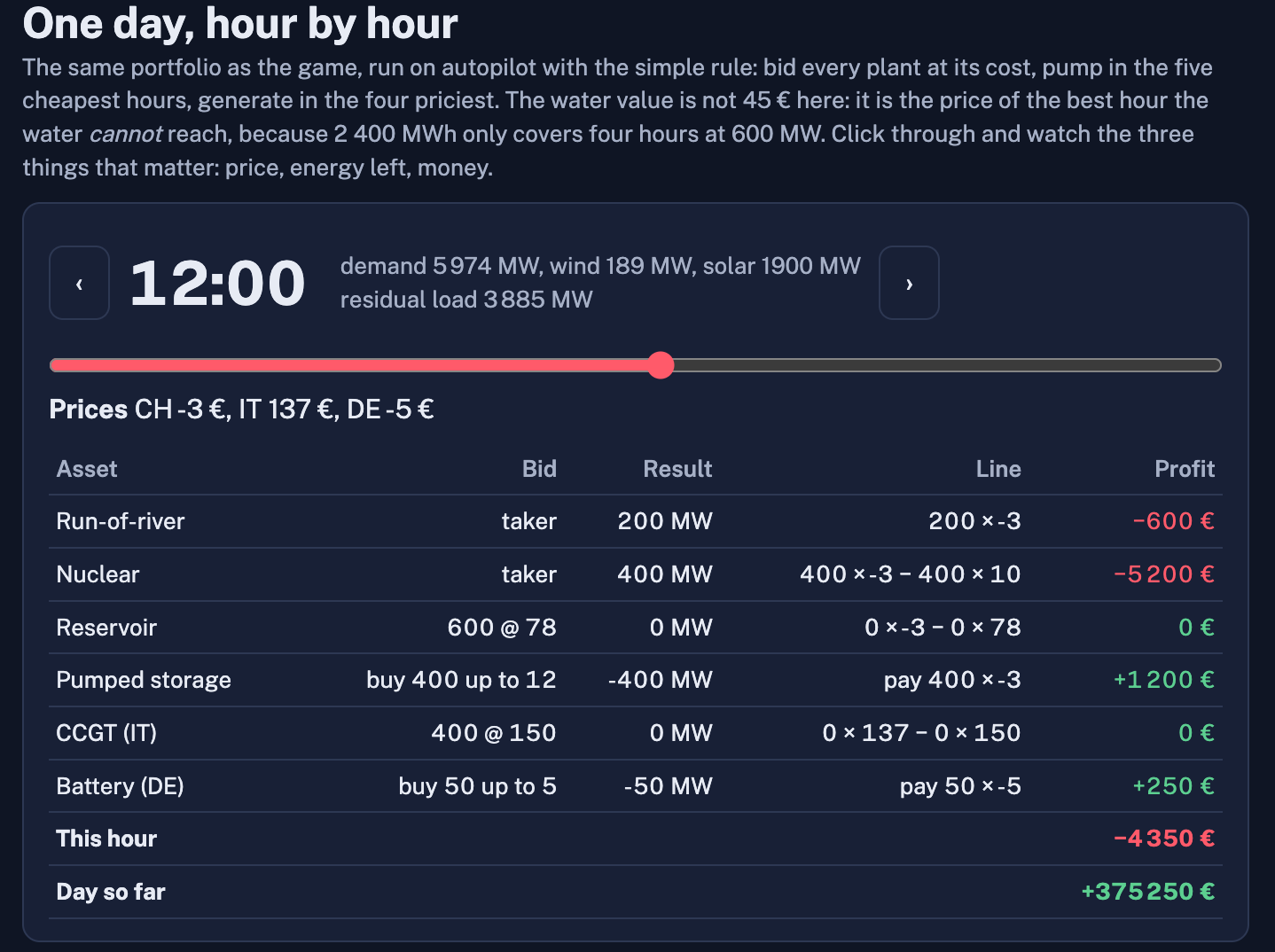
And the same portfolio on autopilot, hour by hour. This is noon: the price is negative in Switzerland and Germany, so run-of-river and nuclear lose money while pumped storage and the battery get paid to fill up.
I learned so much, and I was having fun gaining an understanding of a completely new field.
Four things that surprised me
- Every hour of tomorrow is its own auction, the last plant needed sets the price, and everyone accepted gets that price. So you just bid at your cost and let the market decide. Cheapest to run goes first (solar, wind, nuclear, river hydro), then coal and gas, and whichever gas plant squeezes in last sets the price for everyone.
- A big price gap between Switzerland and nearby countries is not free money. If the border line is full, only the people holding transmission rights can capture it. “Can you actually move the power?” comes before everything else.
- Electricity can be worth less than nothing. Nuclear and river hydro can’t just switch off, so on a sunny midday supply overshoots demand and the price goes negative. You get paid to consume.
- Which is why storage is not a nice-to-have, it’s the whole game. In one of our scenarios the battery got paid to charge at peak production and paid again to discharge at peak consumption. Two paychecks, one day, zero fuel. And a Swiss reservoir is the same trick on a bigger scale: water sitting behind a dam has a price, because it’s the value of the hour you could sell it in later. Storage is what turns “too much sun” into “sell it at dinner time”.
Gude job...dam
HackTheGap, Zurich, 31 October - 1 November 2026